The BORA activated charcoal filters don’t give unpleasant cooking odours a chance and provide constant fresh air when cooking. We cover the most important aspects in relation to your activated charcoal filter and explain why regular filter changes are so important.
Scope of delivery
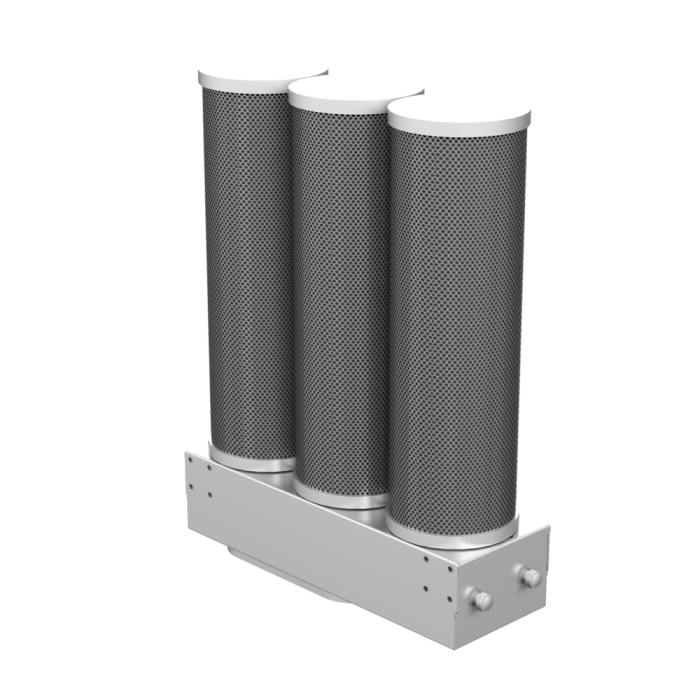
● Air cleaning box ULB3
● 3 x activated charcoal filter cartridges
● fine filter
● Housing plinth
● Fixing screw set
● 2 x angle brackets
● 2 x mounting straps
● operating and installation instructions
Accessories
● ULBAS replacement activated charcoal filter set
product- and planning instructions
● Diverse installation options
● Duct connection shallow 245 x 89 mm
● Access for maintenance must be considered during planning
● A shallow duct connector EFV is needed to form a direct link between the air cleaning box and the shallow duct
● Clearance of at least 2 cm is required to replace the filter cartridges
● Clearance of at least 18 cm is required sideways to replace the filter
● Ensure minimum return flow aperture of 500 cm² (e.g. shortened plinth plate or slatted plinth)
Technical data
Dimensions (WxDxH) 465 x 590 x 150 mm
Weight (incl. accessories/packaging) Approx. 11.5 kg
Casing material Galvanised steel
duct connection BORA Ecotube
Filter material Granular activated charcoal
Activated charcoal granulate volume 8.5 kg
Maximum filter service life 400 h (2 years)
The BORA activated charcoal filters don’t give unpleasant cooking odours a chance and provide constant fresh air when cooking. We cover the most important aspects in relation to your activated charcoal filter and explain why regular filter changes are so important.
WHEN IS AN ACTIVATED CHARCOAL FILTER REQUIRED?
All BORA cooktop extractor systems are available as either recirculation or exhaust air versions. The best type of system for a kitchen depends on the specific planning situation. Both operating modes extract steam, grease particles and odours with equal efficacy but there is a difference: with the exhaust air version, the air drawn in by the cooktop extractor is expelled outside via a duct system. With the recirculation version, on the other hand, the drawn-in air is filtered and returned to the room.
Irrespective of the operating mode, all of our cooktop extractor systems come with an integrated stainless steel grease filter. This is located in the system’s cooktop extractor. The stainless steel grease filter filters grease particles that arise while cooking and can be easily cleaned in a dishwasher.
As the exhaust air version expels the drawn-in air and cooking odours externally, no further filtration is required with this mode. In the recirculation version, on the other hand, a second filtration stage occurs: odour filtration. All BORA cooktop extractor systems in recirculation mode and the BORA X BO use a premium-quality activated charcoal filter to this end. Thanks to the filter’s pore structure, the activated charcoal absorbs cooking odours in its pores like a sponge absorbs water. The odour particles are then stored in the filter’s pores, preventing unpleasant cooking odours from entering the air in the room.
HOW LONG DOES A BORA ACTIVATED CHARCOAL FILTER LAST?
The BORA activated charcoal filters absorb and store unpleasant odour particles, providing fresh air when cooking. However, the filters’ absorption capacity is limited and once the activated charcoal is saturated no further cooking odours can be filtered. This makes regular replacement necessary.
How often and after how long the activated charcoal filter in your BORA system needs to be replaced depends on the specific system and the associated activated charcoal filter. We explain which system requires which filter and when this needs to be changed.
FIGHTING COOKING ODOURS IN THE KITCHEN: ACTIVATED CHARCOAL FOR A FRESH COOKING EXPERIENCE
Air quality while cooking is one of the most important factors for creating a sense of well-being in the kitchen as a living space. Here we explain why good air quality in the kitchen is important and how active charcoal helps reduce smells and humidity.
Open-plan kitchens with spacious room layouts and cooking islands are on trend. Air recirculation systems, which filter air while you’re cooking and then feed it back into the room, are increasingly gaining popularity over exhaust systems. Exhaust systems direct the air outside via ducts. However, this can lead to heat loss, which in turn affects energy efficiency, especially in winter. Innovative filter technologies play a key role in combating this issue.
Cooking can have a significant impact on air quality. Scientific studies at cooking events have shown that up to 75 odorous substances can be released in various concentrations and perceived intensities. Although fewer odorous substances are likely to be released in a normal, domestic kitchen (depending on the dish), there is no denying that cooking has a significant impact on air quality.
To counteract this effect, many kitchens have an integrated exhaust air system that reliably directs odours and steam outside. However, this also means warm indoor air is directed outside, and a fresh supply is required to replace it. An alternative option is a recirculation system, which is more energy-efficient and easier to integrate. All it requires is a highly effective grease filter and an activated charcoal filter.
AIR CIRCULATION SYSTEMS ARE IN
Modern trends in home design not only focus on open-plan kitchens, aesthetic cooking islands and spacious room layouts – they also increasingly place energy saving at the heart of home planning. In this context, air recirculation systems in extractor hoods are becoming increasingly important. In comparison to exhaust systems, they prevent heat loss through warm air being directed outside, especially in winter.
Effective filtration is another important factor that contributes to quality of life in domestic kitchens. If cooking odours are not contained by doors, they can quickly become embedded in furniture, carpets, curtains and clothing.
This is whyhigh-performance cooktop extractor systems are fitted with a recirculation mode consisting of two filter stages to ensure the best possible air quality: grease particles are effectively filtered out of the cooking fumes in the grease filter, while the activated charcoal filter removes odours of all kinds from the air in the second stage. BORA high-performance activated charcoal filters are equipped with different materials so that even the most stubborn odours, such as those from fish and roasts, are effectively retained.
TIP: to ensure optimal performance, only use original BORA activated charcoal filters. The filter should be changed regularly. The BORA cooktop displays an “F” when the filter needs to be changed.
ACTIVATED CHARCOAL FOR FRESH AIR
An activated charcoal filter is usually made up of several layers. Not only does the filter separate particles, it also separates odours. The main component of an activated carbon filter is therefore the activated carbon. The majority of pores in an activated carbon filter are very small in diameter, which is why they are known as “micropores”.
These micropores give the activated carbon its high inner surface area. A micropore is at least 35,000 times thinner than a human hair. Active charcoal can be treated with various other substances to further increase its effectiveness in filtering odour molecules. It can be treated with acids, for example, to improve its capacity to separate fish odours.
Activated charcoal that has been modified in this way is sometimes used in BORA activated carbon filters. Acid-impregnated activated carbon is even used for air purification in the International Space Station (ISS), albeit in larger quantities, namely 22kg.
A BORA activated carbon filter combines physical sorption (in which the odour molecule is physically bound to the surface of the activated carbon) with chemical sorption (which converts and thus eliminates the odour molecule). Both mechanisms are essential in order to effectively remove the bouquet of cooking odours.
SHELF LIFE
At some point, even the best activated charcoal becomes worn out and can no longer fully absorb odours. The lifespan of a BORA active charcoal filter can be from 150 h (PUAKF, BAKFS), 300 h (ULBF), 400 h (ULB3) and 600 h (ULB3X). Of course, the saturation of the activated charcoal filter also depends on your cooking habits. Packed in a protective film, an activated charcoal filter can easily be stored for two years.
| Weight | 1.000000 |
|---|---|
| Is KIT Product | No |
| Brand | BORA |
| Most Recent | No |
| Is Top | No |
| Warranty | Warranty |
| Ship Bundle Items | Together |
| Custom Width Enable | No |
BORA ULB3X AIR PURIFCATION BOX WITH 3 ACTIVATED CHARCOAL FILTERS **WHOLE SYSTEM** REPLACES ULB3


● Service life approx. 400 h/2 years
● Combination of activated charcoal filter cartridges and upstream fine filter
● Effective odour removal
● Complete BORA system